
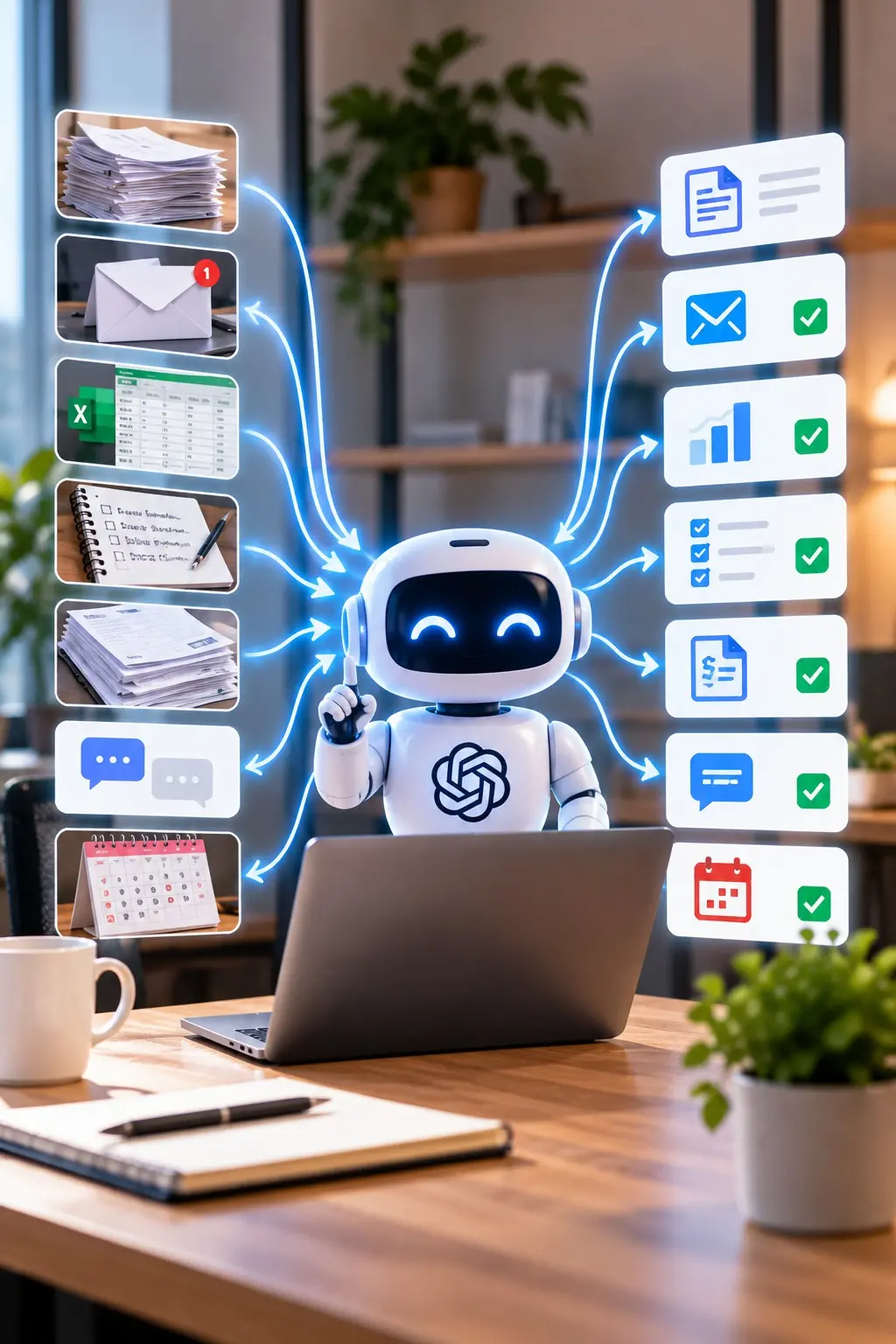
Everything in your job that repeats can potentially be automated and performed by artificial intelligence instead of you.
That does not necessarily mean AI can replace your entire position. It means the repetitive parts of your work are the most likely to be handed over to software.
Think about the actions you perform every day or every week:
- Writing similar emails to different customers
- Turning meeting notes into summaries and task lists
- Copying information from one system into another
- Preparing reports from the same type of data
- Creating invoices or standard documents
- Answering frequently asked questions
- Reviewing applications against a fixed set of criteria
- Researching the same categories of information
- Reformatting content for different platforms
- Scheduling appointments and sending reminders
- Sorting messages, documents, or customer requests
- Creating first drafts from an established template
If a process follows a recognizable pattern, AI may be able to complete some or all of it. The main requirement is knowing how to describe the task correctly.
In This Article
- Why repetitive tasks are the easiest to automate
- How to give AI clear and effective instructions
- A simple formula for assigning work to AI
- Why every AI-generated result still requires review
- How AI may transform jobs without eliminating them
- Why workplace expectations are likely to increase
- How jobs can be created and displaced at the same time
- Which human abilities remain difficult to automate
- Why entry-level workers may face particular challenges
- Whether learning AI is enough to protect a career
- How to evaluate the risk to your own job
Why Repetitive Tasks Are Easier to Automate
AI works best when a task follows a pattern.
If the same type of information goes in and the same type of result is expected each time, the process may be suitable for automation. The task becomes even easier to automate when it is performed entirely on a computer and follows clear rules.
Consider a weekly report. An employee may collect numbers from the same sources, place them into the same categories, compare them with the previous week, and write a short summary.
The information changes, but the process remains largely the same.
AI can potentially help collect or organize the data, identify changes, prepare the summary, and format the final document. A person may still need to verify the numbers and explain why something happened, but much of the routine production work can be reduced.
The same principle applies to emails, meeting notes, customer questions, invoices, schedules, research, data entry, and document preparation.
The easier a process is to explain step by step, the easier it may be to automate.
How to Give AI Clear and Effective Instructions
Many people try an AI tool once, receive a generic or inaccurate answer, and conclude that it cannot help with their work.
The problem is often not the tool itself. It is the instruction.
Imagine asking a new employee to “prepare the report” without explaining which report, where to find the information, who will read it, what format to use, or when it is due. Even a talented employee would have to guess.
AI behaves in a similar way. A vague request produces a result based on assumptions. A well-defined request gives the system a process to follow.
An effective AI instruction should include five elements.
1. Define the Role
Tell the AI what kind of perspective it should use.
For example:
Act as a customer support specialist for a small online clothing store.
This establishes the context. The same customer message might require a different response from a lawyer, salesperson, technical specialist, or support representative.
2. State the Task Clearly
Describe the specific action you want completed.
Avoid a vague request such as:
Help me with this email.
Use a specific instruction instead:
Write a response to a customer who received the wrong item and is requesting a replacement.
The second version gives the AI a clear objective.
3. Provide the Necessary Context
Include the information required to make the result relevant. This may involve company policies, background details, examples, data, definitions, or information about the intended audience.
For example:
Our policy allows a free replacement when the wrong item was shipped. The customer does not need to return products worth less than $25.
Without this context, the AI may invent a policy or recommend a process that does not apply.
Sensitive business, customer, financial, medical, or personal information should not be entered into an AI system unless the employer has approved the tool and its use for that type of data.
4. Specify the Desired Output
Explain what the final result should look like.
You might specify:
- Length
- Format
- Tone
- Reading level
- Required sections
- Words or claims to avoid
- Whether the answer should be a table, summary, email, checklist, or report
For example:
Write a friendly email of no more than 150 words. Apologize, explain the replacement process, and end by asking the customer to confirm the shipping address. Do not use legal language or offer a refund.
Clear limits reduce the amount of editing required later.
5. Explain How to Evaluate the Result
Tell the AI what a successful answer must accomplish.
For example:
The response should make the customer feel heard, clearly explain the next step, and avoid promising a delivery date.
This is especially useful for complex tasks because it gives the system a standard against which to shape its answer.
A Simple Formula for Assigning Work to AI
A practical instruction can follow this structure:
Role + task + context + format + rules + success criteria

Here is a complete example:
Act as an administrative assistant. Turn the meeting transcript below into a concise summary for employees who could not attend. Begin with a three-sentence overview, followed by a bullet list of decisions, assigned tasks, responsible people, and deadlines. Do not add information that is not present in the transcript. If a responsible person or deadline is unclear, label it “Not specified.” The result should allow someone to understand the decisions and next steps in less than two minutes.
This instruction works because it does not merely request a summary. It describes the purpose, structure, limitations, and definition of a useful result.
The first response does not have to be final. A person can review it and provide additional instructions:
- Make the language less formal.
- Shorten the introduction.
- Separate confirmed decisions from suggestions.
- Add the source for every number.
- Identify information that may require verification.
- Rewrite the explanation for a reader without technical knowledge.
For a task that happens regularly, the instruction can become a reusable template. Each week, the user supplies new source material while keeping the same process and output requirements.
That is where AI begins to function less like an occasional chatbot and more like part of a workflow.
Always Review the Result
A good instruction can improve an AI-generated answer, but it cannot guarantee accuracy.
AI may misunderstand the source material, omit an important detail, invent a fact, use the wrong tone, or produce an answer that appears convincing but is incorrect.
Human review remains essential, especially when the work affects:
- Money
- Employment decisions
- Contracts
- Health or safety
- Customer commitments
- Confidential information
- Legal or regulatory compliance
- A company’s reputation
The person reviewing the output should ask:
- Are all factual claims supported by the source material?
- Has any important information been omitted?
- Did the AI make assumptions that were not included in the instructions?
- Is the tone appropriate for the audience?
- Does the result follow company policies?
- Could an error cause financial, legal, or personal harm?
- Is confidential information being handled appropriately?
AI can complete a process. It cannot automatically accept responsibility for the consequences.
AI Is More Likely to Change Jobs Than Eliminate Them
The possibility of automating routine work has left many workers asking an uncomfortable question: Will AI eventually replace me?
The concern is widespread. According to a 2025 Pew Research Center survey, 52% of American workers said they felt worried about how AI might be used in the workplace. About one-third believed it would lead to fewer job opportunities for them in the long run.
Those fears are understandable. AI is developing quickly, and employers are under constant pressure to reduce costs and increase productivity.
However, AI does not usually encounter a job as one indivisible activity. It encounters individual tasks.
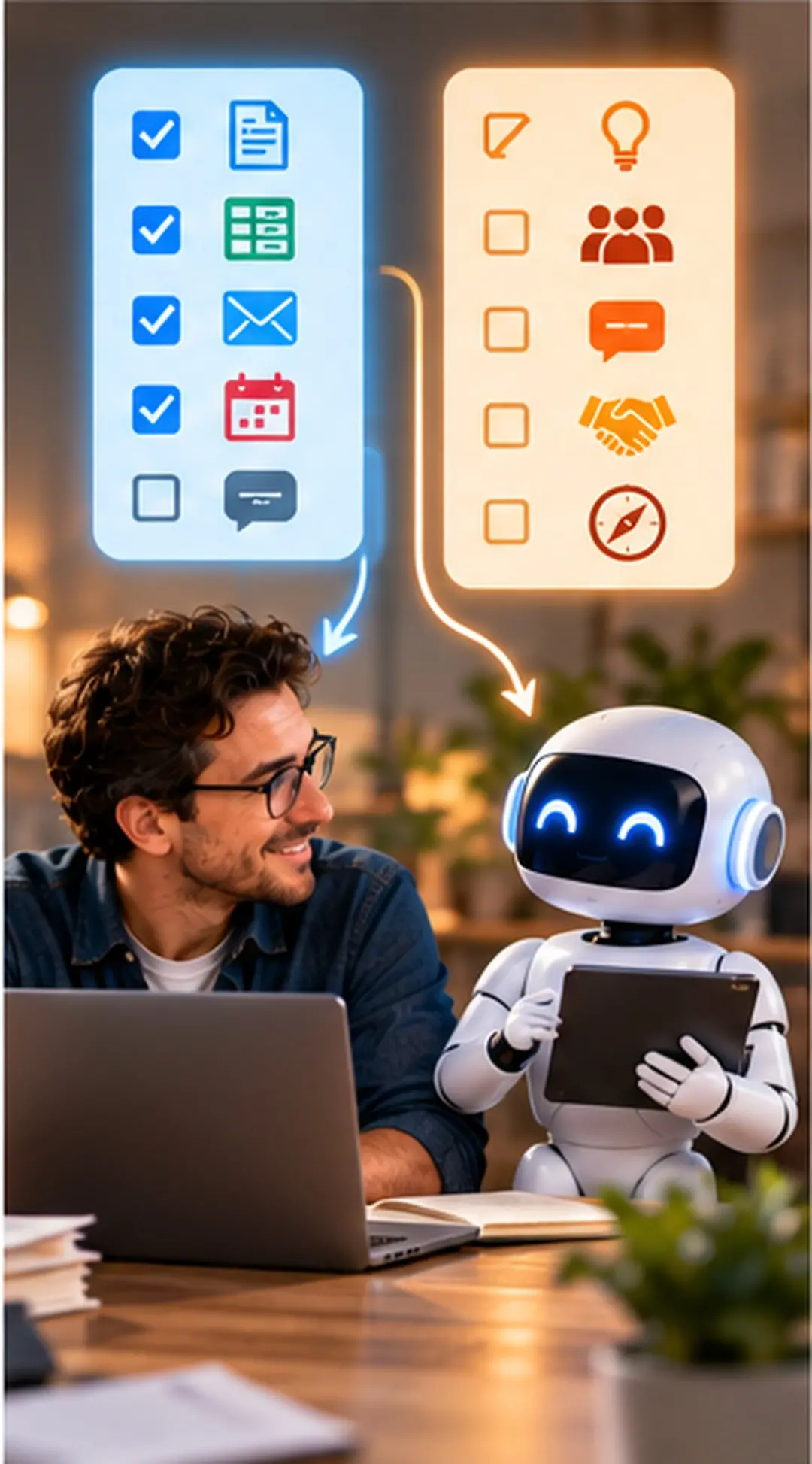
A marketing manager may analyze campaign data, write briefs, attend meetings, negotiate with vendors, mentor employees, approve creative work, and present results to senior leadership. AI may help with several of those activities without being capable of assuming the entire role.
The same applies to teachers, accountants, designers, recruiters, attorneys, sales representatives, and other professionals. Some parts of their work are easier to automate than others.
A 2025 study from the International Labour Organization found that one in four workers worldwide had a job with some degree of exposure to generative AI. However, the researchers concluded that transformation—not complete replacement—was the more likely outcome for most occupations.
This does not mean job losses will not occur. Some positions will disappear, teams may become smaller, and certain entry-level responsibilities may no longer require as many people.
At the same time, many existing jobs will be reorganized around a new division of labor between people and technology. The job title may remain while the daily work changes significantly.
The First Change May Be Higher Expectations
For many workers, AI’s immediate effect may not be losing a job. It may be a change in what employers expect one person to accomplish.
If an employee can use AI to turn meeting notes into a summary, draft a follow-up email, and organize action items in a few minutes, a company may stop treating those activities as substantial pieces of work.
A report that once took three hours may be expected in thirty minutes. A marketer may be asked to test more campaign ideas. A customer service representative may handle more complex cases while an automated system deals with routine questions.
AI can therefore raise the expected speed and volume of work even when it does not remove the employee.
This may also change hiring. Employers could place less value on the ability to produce a basic first draft and more value on judgment, verification, subject knowledge, and the ability to improve AI-generated material.
The risk is not simply that a machine will take a person’s job. It is that the definition of a capable worker may change faster than some people can adapt.
Jobs Are Created and Displaced at the Same Time
Technological change rarely moves the labor market in only one direction.
The World Economic Forum’s Future of Jobs Report 2025 projected that major economic and technological trends could displace 92 million jobs globally by 2030. The same report projected the creation of 170 million new roles, producing a net increase of 78 million jobs.
These estimates cover more than AI alone and should not be treated as a precise forecast. They do, however, illustrate an important point: job destruction and job creation can happen simultaneously.
Demand is expected to grow for AI specialists, software developers, cybersecurity professionals, and data experts. But growth is not confined to technology. Caregiving, education, construction, delivery, and other frontline roles are also expected to expand.
Meanwhile, some clerical and administrative positions are likely to decline as organizations automate routine processes.
The result will not be a future in which every worker becomes a programmer. It will be a labor market in which different combinations of technical knowledge, practical expertise, and human judgment become valuable.
What AI Still Cannot Reliably Do
AI systems can produce polished answers while making serious mistakes. They may invent facts, misunderstand context, reproduce bias, expose confidential information, or recommend something that looks reasonable but is inappropriate for the situation.
People remain especially important when work requires:
- Accountability for a final decision
- Trust and relationship building
- Ethical or legal judgment
- Leadership and conflict resolution
- An understanding of unspoken context
- Physical presence or manual skill
- Empathy in sensitive situations
- Original strategic thinking
- Verification of facts and quality
- Responsibility when something goes wrong
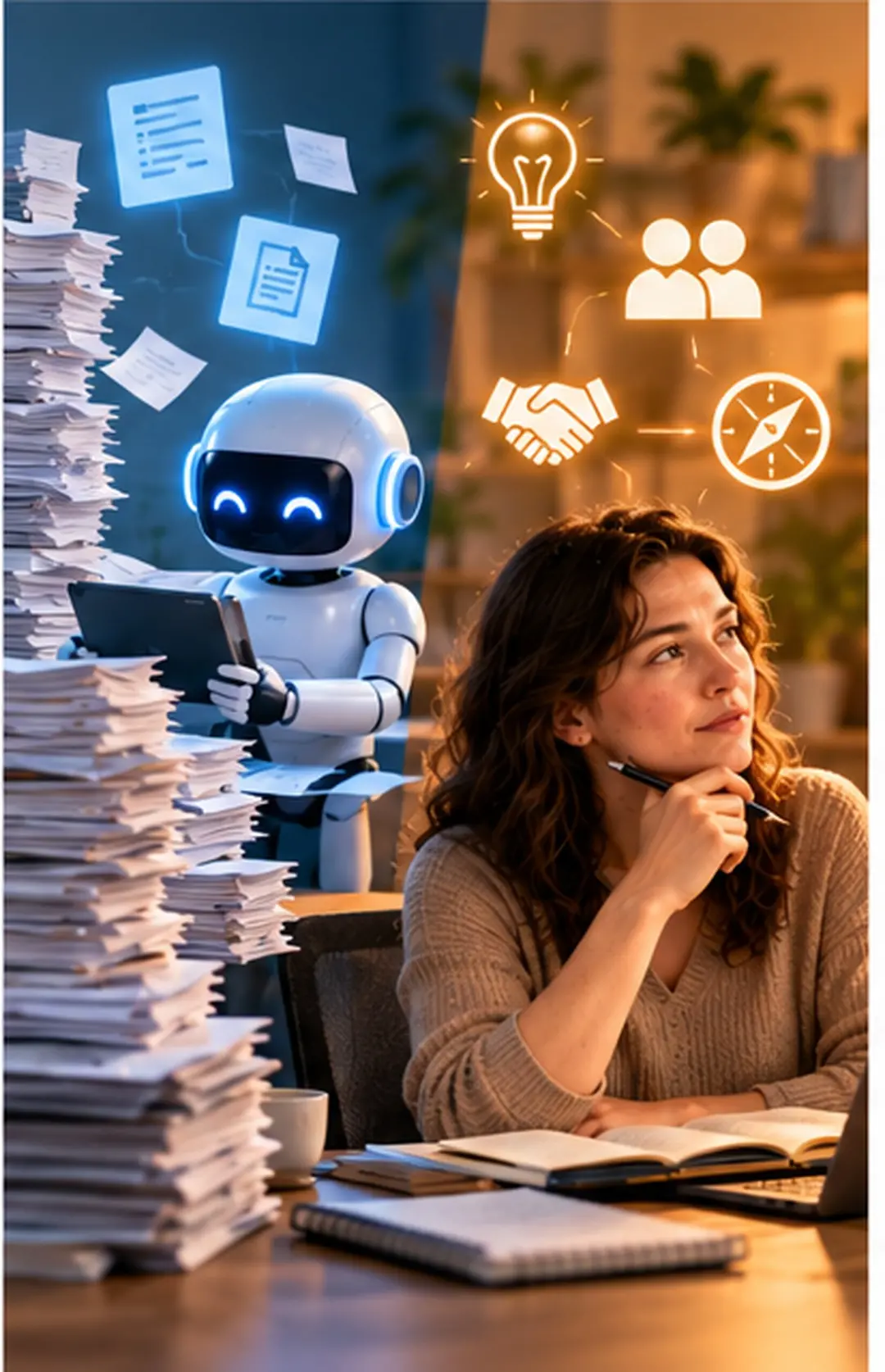
These qualities do not make a profession immune to change. A manager who depends on judgment and communication may still automate much of the administrative work surrounding those responsibilities.
However, they help explain why a job cannot always be reduced to the production of text, images, calculations, or recommendations.
Entry-Level Workers May Face a Particular Challenge
New employees traditionally learn through basic assignments: conducting research, preparing drafts, organizing information, taking notes, or completing routine analysis.
These tasks help people understand an industry before they receive more complex responsibilities. They are also among the tasks AI can perform most easily.
If companies automate too much junior-level work, they may weaken the training path that produces experienced employees. Organizations could save money in the short term while creating a shortage of qualified senior workers later.
Younger workers may therefore need to demonstrate judgment and industry knowledge earlier in their careers. Employers, meanwhile, will have to decide how people develop those abilities if software performs much of the work that once served as practice.
This is not only a technology issue. It is a management and education issue as well.
Learning AI Is Useful, but It Is Not the Whole Answer
Knowing how to give AI clear instructions may provide an advantage today. As the technology becomes easier to use, however, that ability may become an ordinary workplace skill—similar to using search engines, email, or spreadsheets.
The greater advantage may come from combining AI ability with something harder to copy:
- Deep knowledge of a field
- The ability to recognize a bad result
- Clear communication
- Creative direction
- Leadership
- Customer understanding
- Sound decision-making
- Professional credibility
A person who understands an industry can assign better tasks, provide more useful context, notice important mistakes, and determine whether the result is actually suitable.
The technology may produce the first draft. Expertise determines whether that draft deserves to become the final version.
So, Will AI Replace Your Job?
There is no single answer.
AI will eliminate certain tasks and contribute to the decline of some positions. It will also create new responsibilities, change performance expectations, and become a normal tool inside many existing professions.
The most useful question is not whether AI can perform your entire job today.
Ask instead:
- Which parts of my work repeat?
- Which tasks follow clear rules?
- Which activities mainly involve processing digital information?
- Which decisions require my experience or judgment?
- What could go wrong if the AI’s answer were inaccurate?
- Who remains responsible for the final result?
AI is unlikely to replace every worker in an occupation at once. More often, it will enter the workplace one task at a time.
The repetitive activities will change first. The people who understand how to describe, supervise, and verify those activities will be in a stronger position than those who ignore the transition.
The future of work is not simply humans competing against machines. It is a continuing decision about which tasks should be automated, which decisions require a person, and who is responsible when the two work together.