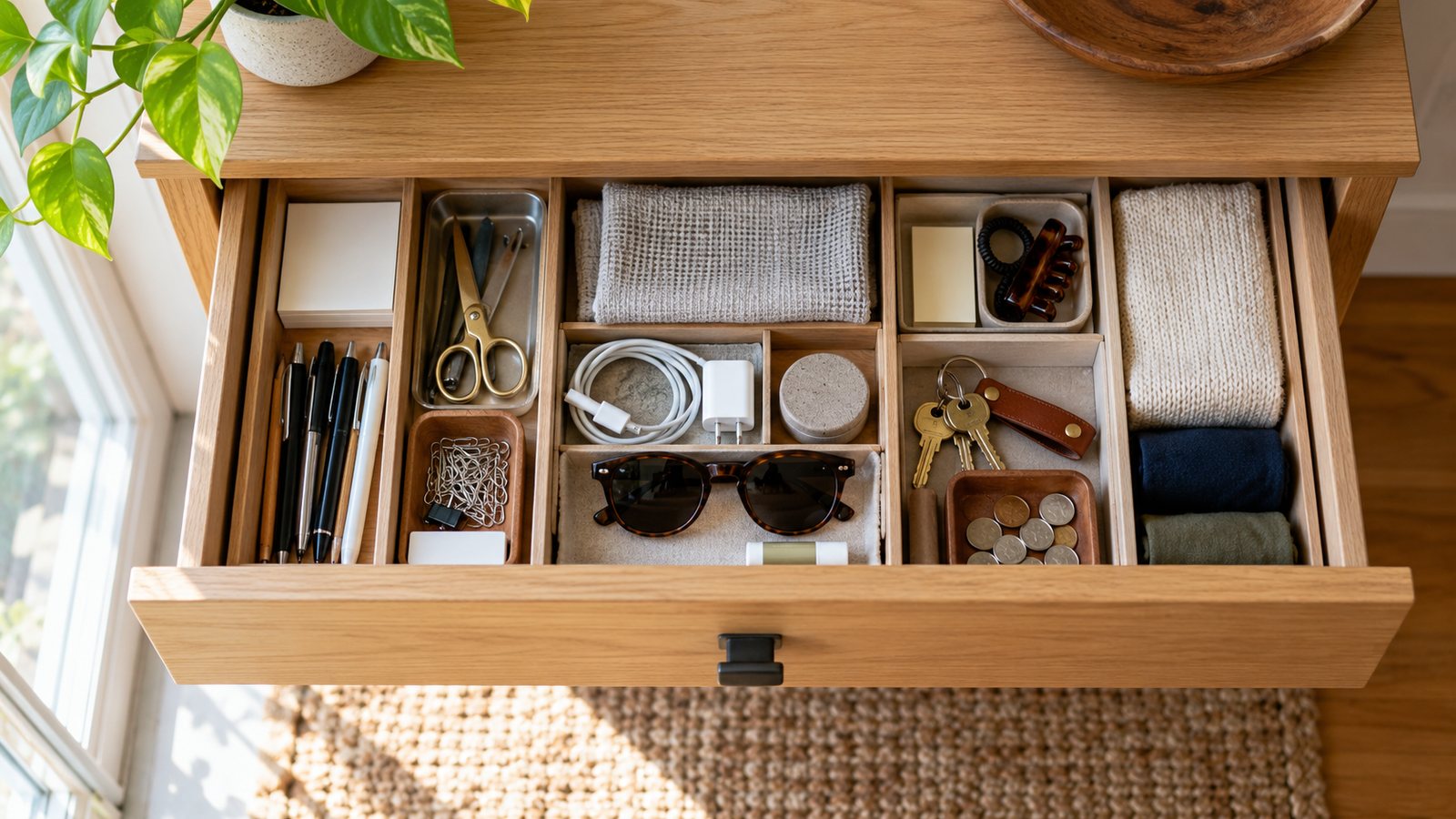
The best drawer layout lets you find an item, take it out and put it back without moving a pile. Start with what you reach for every day. Choose the organizer after you understand those movements.
Below are three layouts for the same example drawer. These are design examples, not results from a household trial. Use the short test at the end to find what works in your own home.
Measure the usable space first
Empty one drawer onto a towel and group items by purpose. Remove things that belong elsewhere, return duplicate tools to their usual place and keep only the items this drawer needs to hold.
Measure the interior width, front-to-back depth and usable height. Check the opening too: a tall bin may fit inside but catch the frame when the drawer closes. Note curved corners, screws and the point beyond which your hand cannot comfortably reach.
Our example interior is 16 inches wide, 14 inches deep and 3 inches high. It holds keys, pens, a charging cord, tape, scissors and small clips. All dimensions below are illustrative; measure the actual products, including their rims.
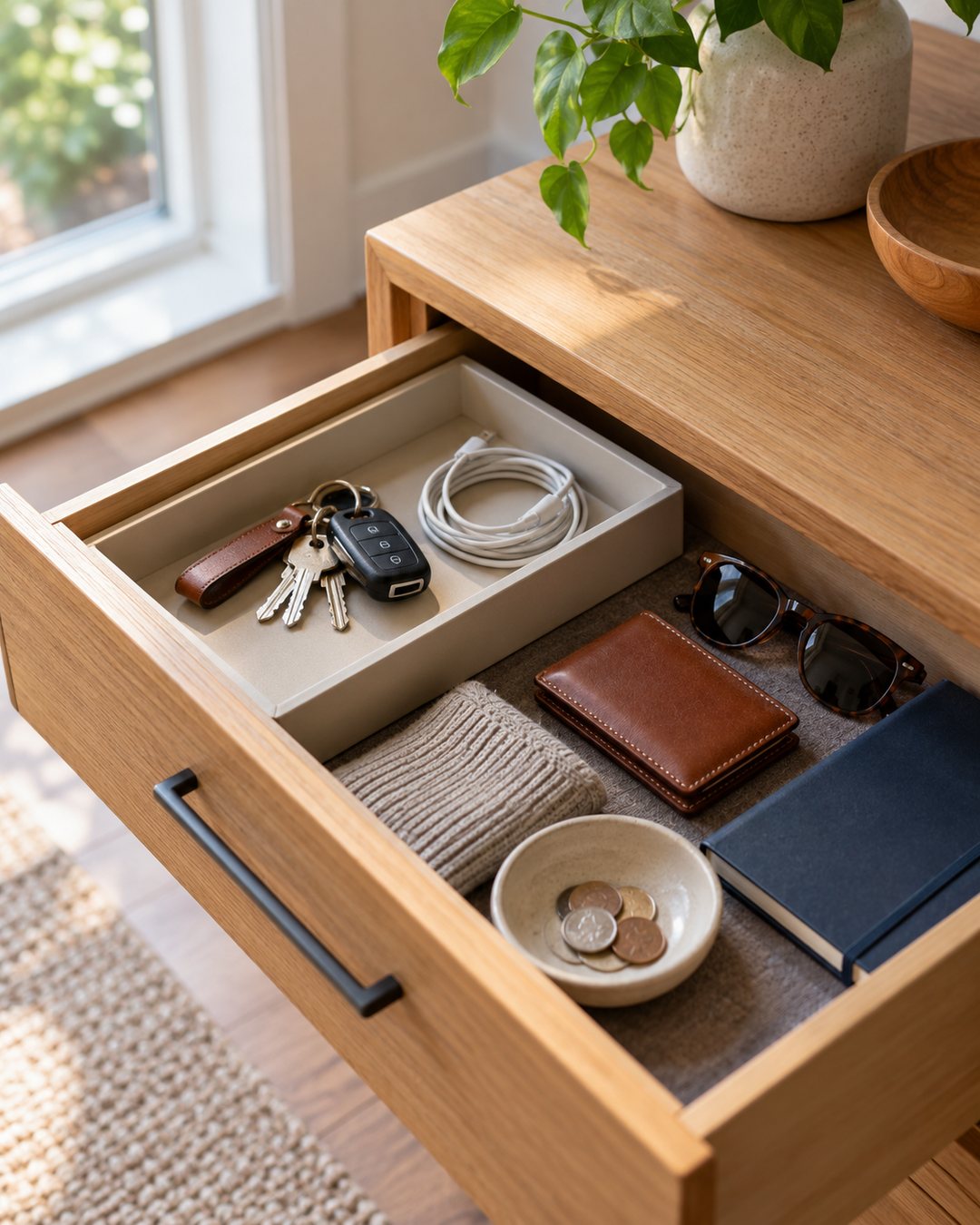
Layout 1: One removable tray
Place a shallow 10-by-6-inch tray across the front. Put the daily keys and charging cord in it. Keep long items beside or behind it, with scissor blades closed and safely contained.
Choose this when: only a few categories need separation, or you often lift a group of supplies out together.
Watch for: small objects sliding around outside the tray. If clips collect under the scissors, this layout needs one small contained section rather than another full-size tray.
Try a sturdy shallow box you already own first. It can reveal the useful footprint before you spend money on a permanent organizer.
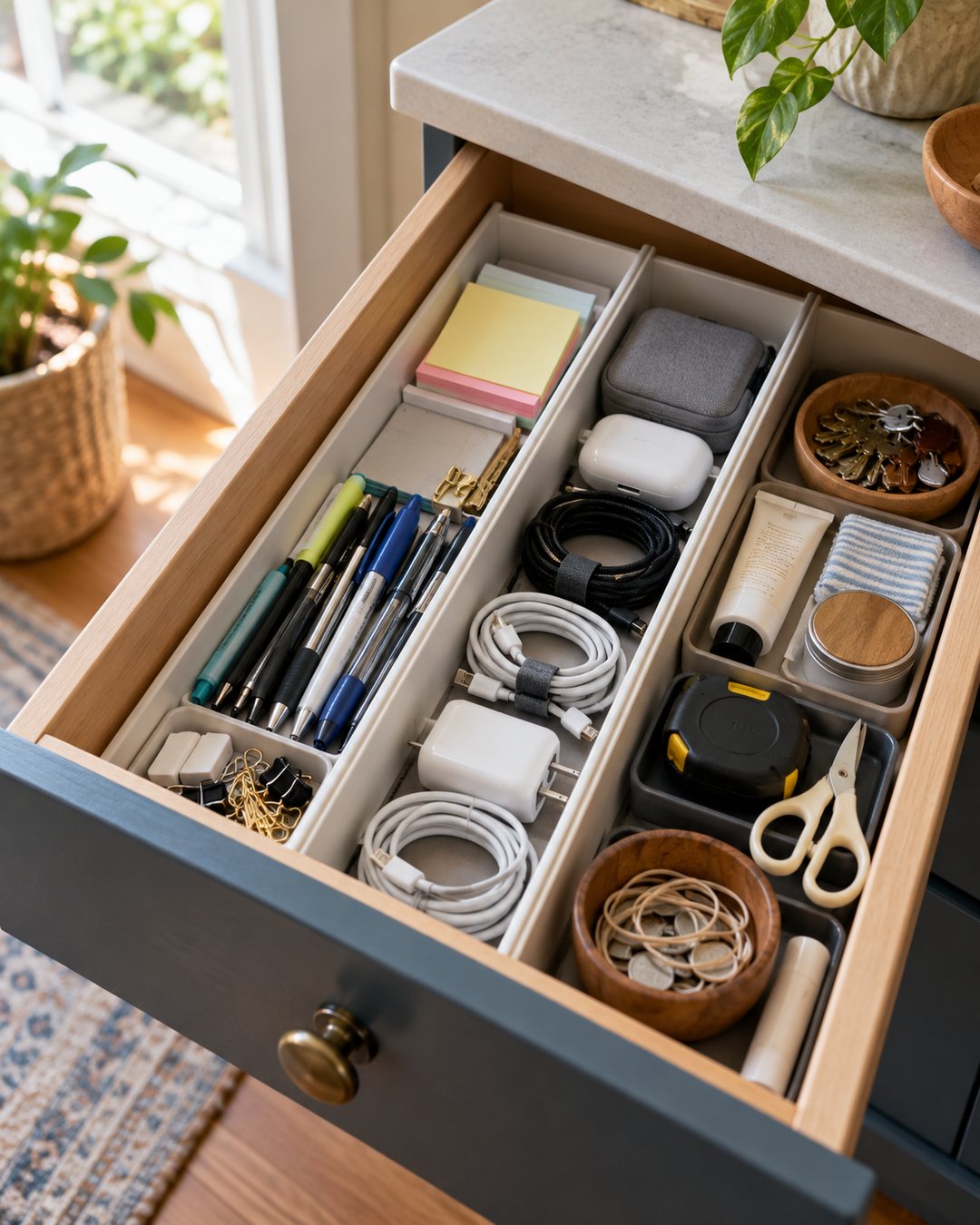
Layout 2: Long lanes with dividers
Run two front-to-back dividers to create three lanes. Allow for divider thickness when checking whether the total width fits. Put pens in one lane, cables in another and larger tools in the third.
Choose this when: most items are long and narrow, and each category benefits from a continuous space.
Watch for: tiny items drifting to the back and dividers shifting when the drawer moves. A divider should remain secure without forcing the drawer sides apart. Avoid stacking tools into a lane so deeply that the item you need is hidden.
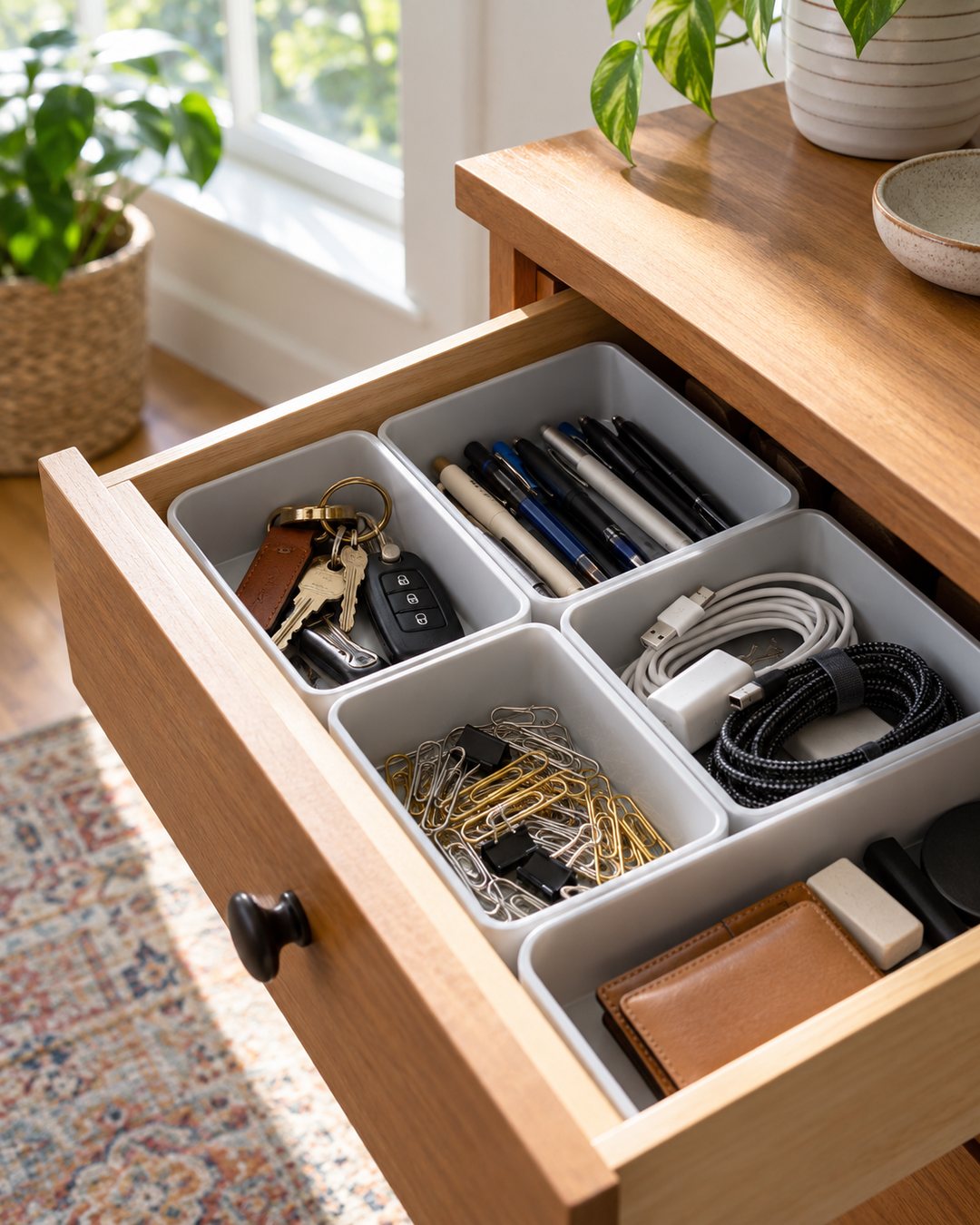
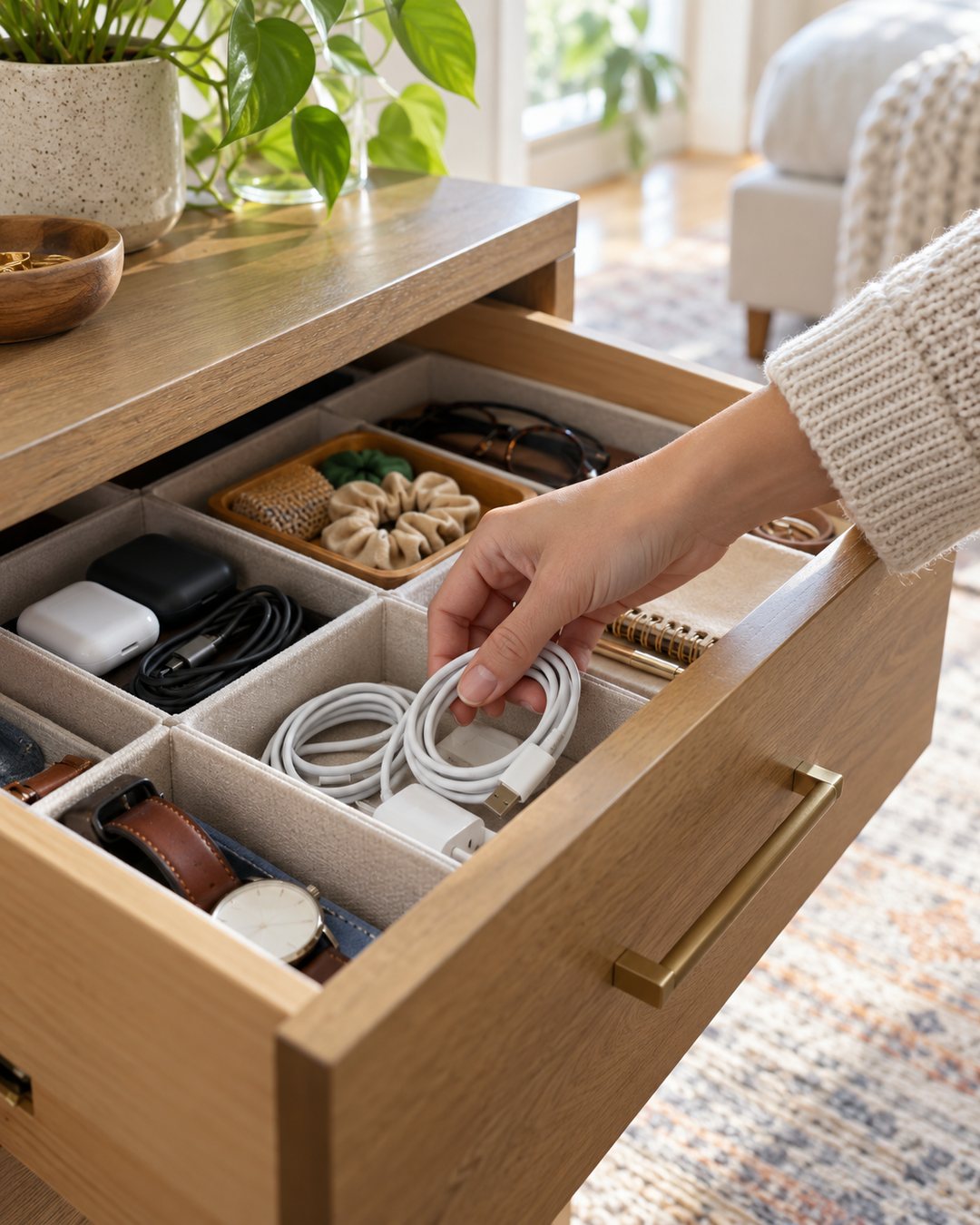
Layout 3: Small modular bins
For the 16-by-14-inch example, four bins with an outside footprint of 7.5 by 6.5 inches can form a two-by-two grid. Together they occupy 15 by 13 inches, leaving clearance in both directions. The bins must also fit below the 3-inch height limit.
Put daily items in the front pair and occasional supplies in the rear pair. Give clips their own small inner cup if they disappear under larger objects.
Choose this when: you have several small categories and want to lift one category out.
Watch for: space lost to thick walls and rims. Six attractive containers that do not fit your objects are less useful than two simple ones that do. Leave a sensible place for the longest item.
Run a one-week retrieval test
Pick the layout that matches your objects, then record real use for a week. You do not need laboratory precision; the goal is to notice repeated friction.
- Find: can you see the item without digging?
- Take: must you lift another object first?
- Return: can it go back into its place easily?
- Close: does the drawer close without catching anything?
Use this copyable note: Item / where it lives / what got in the way / one change to try. For example: “Charging cord / rear bin / had to move tape / swap with daily keys bin.” That is a proposed adjustment, not a measured result.
If objects keep landing outside their sections, first make the sections easier to use. If there is simply too much inside, reduce the contents before adding another layer of containers.
Keep medicines, loose batteries and sharp objects in appropriate safe storage rather than mixing them into a general household drawer.
Next: Measure an organizer before buying it. This article’s layouts and test template are original worked examples; they do not claim a universal winning arrangement.
Images are AI-generated illustrations, not screenshots, product tests or evidence of a real customer quote.